Showing posts with label ProfPrac. Show all posts

Sunday, December 4, 2016

Architects' Guidelines: Methods of Compensation and Schedule of Fees

Here is a condensed version of the Architects' Guidelines: Methods of Compensation and Schedule of Fees which was recently approved by the PRC Board of Architecture thru PRBoA Resolution No. 6 s2016. This copy is based on the submitted document to PRBoA in 2014.


Download a copy of the above condensed version HERE.
Download full copy of the Architects' Guidelines (as submitted to PRBoA in 2014) HERE.

Tuesday, July 21, 2015

Registration with UAP for New Architects

PRBoA Resolution No. 5 series of 2015 requiring all successful examinees in the licensure examinations for architects to present the official receipt/certificate of payment of membership fee issued and signed by the authorized officer of the Accredited and Integrated Professional Organization (IAPO) prior to registration as Architects.


Admission to the APEC Architect Register

Candidates for registration as an APEC Architect must apply to the Monitoring Committee of their home economy to determine their eligibility for enrolment on that economy’s section of the Register. In addition to details on education, training and professional recognition in any APEC jurisdiction, candidates will be required to submit a report on their post registration / licensure professional experience, outlining the categories of practice in which it was undertaken and the level of their involvement.

APEC Architects must also agree to be bound by the code of professional conduct of their home economy and of any jurisdiction in which they practice.

Particulars of APEC Architects to be recorded on the Register include:

  • name and business address;
  • home economy or jurisdiction in which the architect is registered/licensed; and
  • any other economy in which the architect is registered/licensed.

Applications for admission to the APEC Architect Register are dealt with in a timely manner and will not normally exceed three months for completion. On admission to the Register, APEC Architects are issued with a Central Council Certificate of Registration by the home economy Monitoring Committee and an APEC Architect Identification Card bearing the architect’s name, name of home economy and date and currency of APEC Architect registration. On request, Monitoring Committees also provide relevant information to the regulatory authorities of other participating economies for registration purposes.

The registration numbers assigned to APEC Architects by Monitoring Committees are preceded by the following abbreviations of the name of the home economy:

Australia - AU
Republic of Mexico - MX
Canada - CA
New Zealand - NZ
People’s Republic of China - CN
Republic of the Philippines - PH
Hong Kong , China - HK
Singapore - SG
Japan - JP
Chinese Taipei - CT
Republic of Korea - KR
Thailand - TH
Malaysia - MY
United States of America - US

Guidelines for Applicants

APEC Architect registration applies only to individual persons.

To be eligible for admission to the APEC Architect Register, candidates must demonstrate to the Monitoring Committee of their home economy that they:

  • have completed an accredited/recognised program of architectural education;
  • have fulfilled the necessary pre-registration experience requirements;
  • are currently registered / licensed as architects in their home economy;
  • have gained at least seven years of professional experience as an architect in specified categories of practice;
  • comply with continuing professional development obligations prescribed by the home economy regulatory authority;
  • are bound by a home economy code of professional conduct.


Flowchart for Assessment Processes


Maintaining APEC Architect Registration

APEC Architect registration is to be renewed on payment of an administration fee to a Monitoring Committee at intervals no greater than two years. Registration details are to be reviewed and renewed on application to practise in a host economy.

Renewal of registration is subject to compliance with home economy regulatory authority or Monitoring Committee requirements to undertake programs of continuing professional development, or fulfil other tests of current competence. The Monitoring Committee may impose conditions on architects who have not practised in a position of professional responsibility during the preceding two years.


The registration of an APEC Architect will be cancelled if the architect ceases to be registered /licensed in the designated home economy. The registration of APEC Architects found , subject to due process, to be in breach of the code of professional conduct of either their home economy, or a host economy, might also may be suspended by their home economy Monitoring Committee.

APEC Architect Operations Manual


Friday, June 19, 2015

WHO SHOULD SIGN?


Developments in recent years witness how the practice of architecture has been appropriated by many entities who are not academically trained or professionally qualified to engage in the practice of the profession.  This situation had eroded the local and international professional standing of the Filipino architect and has resulted in the architectural planning and design of buildings by unqualified entities who have no professional competence for the erected structures. 

It is high time that the Filipino public be assured that only individuals who have been properly educated, qualified and trained will undertake the architectural planning and design of buildings and be held responsible for such acts.

More than half a century ago just after World War II, RA 545 or the old Architecture law allowed non-architects to participate in the preparation of plans and specifications of buildings, which is the primary function of an architect to assist in the immediate rebuilding of the country. At that time, there were only about 350 architects in the Philippines. In 2004, there were about 17,000 registered and licensed architects representing an almost 500% increase spread out over a half century. And since the devastation brought about by the 2nd World War has been properly addressed already, it is but necessary to give unto the architects the performance of a function for which they were specifically trained.

Thus in 2004, RA 9266 or the Architecture Act of 2004 was purposely enacted to, among others, curtail the practice of non-architects signing architectural documents, which are not within their area of competence or expertise. 

R.A. 9266 is clear and categorical — only architects can prepare and sign architectural documents.  There are no ifs or buts about it.  The law does not provide for any exception. Only architects.  No one else can prepare or sign architectural documents.

This exclusivity is clear from the plain language of the said law.  Section 20(5) of the said law provides that “[a]ll architectural plans, designs, specifications, drawings and architectural documents relative to the construction of a building shall bear the seal and signature ONLY of an architect.” 
Further, to ensure that the exclusivity given to architects is actually implemented, Section 20[2] provides that building officials cannot accept or approve “any architectural plans or specifications which have not been prepared and submitted in full accord with” it, i.e., architectural plans which are not signed by architects.

A decade after the passage of RA 9266, not much has been achieved. Non-architects have continued to prepare, sign and seal architectural plans and documents and the real intent of RA 9266 in protecting and assuring the public that only Architects can offer and provide architectural services has not been realized. 

As professionals, architects have a primary duty of care to the communities they serve. Architects bring to society unique skills and aptitudes essential to the sustainable development of the built environment and the welfare of their societies and cultures. Given the public interest in a quality, sustainable built environment and the dangers and consequences associated with the development of that environment, it is important that architectural services are provided by properly qualified professionals for the adequate protection of the public. This need is further amplified by the recent natural calamities that the country has experienced. Resilient, sustainable and well-planned communities will greatly mitigate the effects of natural calamities in the lives of the Filipinos. Undoubtedly, architects will play a crucial role in the development new and existing communities to be resilient, sustainable and well planned. 

Moreover, the impending ASEAN integration has also manifested the need to prepare the Filipino architect’s qualifications to practice architecture in other jurisdictions. There is also a need to ensure that our laws on professionals are aligned with international and regional standards, as well as attuned to global best practices, if we are to preserve our competitiveness and foothold in the regional market. Based on international standards, architectural design, plans and documents properly belong to and are the domain of the architects.  

With an increasing number of architects totalling around 35,000 as of this year, the enactment of HB 5127 and SB 2623 will be a significant step in protecting and assuring the public that only Architects who possess the necessary skills, knowledge and expertise can offer and provide architectural services, as well as comply with the provisions of the ASEAN Mutual Recognition Agreement signed by the Government.

The provisions in the proposed bills are rooted on the training, competencies and functions of architects. In terms of academic requirements, architects are academically competent to practice architecture, and to prepare and certify architectural documents.  A typical architecture course has ten semesters of mainstream architecture (10 architectural design subjects, site planning, urban design and community planning, tropical design, graphics, visual techniques, etc.), and units in building technology and building utilities (mechanical and electrical systems, sanitary and plumbing systems, lighting and acoustics) and even structural systems.

Moreover, in order to qualify for the architectural licensing exam, an architectural degree holder must act as apprentice under a practicing architect for two (2) years. The board exam itself covers the same major subjects in a mainstream architecture course. All of these prove that architects are specifically qualified, through the proper education and training, to prepare and sign architectural documents.

In RA 545, architects were allowed to do structural designing for structures up to 4-storeys high. Under RA 9266, that scope was removed from the practice of architects as the specialization on that subject and practice belongs to other professionals.

And so, if you are going to ask "Who will Sign?", the answer is plain and simple. Architects signing for architectural plans and documents, engineers signing for engineering plans and documents which include structural, mechanical, electrical, sanitary, plumbing, electronics and auxiliary systems. And if you read the minutes in the congressional readings for RA9266, somebody remarked, "Ang para kay Pedro ay kay Pedro, at ang para kay Juan ay kay Juan".

Tuesday, March 24, 2015

HB 5127 and SB 2623 gathers support from architects

In 2004, Congress enacted Republic Act No. 9266 or the Architecture Act of 2004.  This law categorically provides, without any exception, that only duly licensed architects can sign architectural plans and documents. To give teeth to this mandate, the law further provides that building officers cannot accept architectural plans and documents which are not signed by architects.  Congress thus removed the overlaps between the practice of architecture and the other professions, including civil engineering.

“Now that the devastation brought about by the Second World War (which allowed civil engineers to participate in the preparation of plans and specifications of buildings, which is the primary function of an architect) has been properly addressed, it is but necessary to give unto the architects the performance of a function for which they were specifically trained.”

HB 5127 and SB 2623 seeks to strengthen the Architecture profession, amending for the purpose certain provisions of RA 9266, otherwise known as the Architecture Act of 2004.

“Architects have been practicing their art and science since antiquity. The profession as we know it today has undergone extensive growth and change. The profile of architects’ work has become more demanding, clients’ requirements and technological advances have become more complex, and social and ecological imperatives have grown more pressing. These changes have spawned changes in services and collaboration among the many parties involved in the design and construction process.

As professionals, architects have a primary duty of care to the communities they serve. This duty prevails over their personal interest and the interests of their clients.

Members of the architectural profession are dedicated to standards of professionalism, integrity, and competence, and thereby bring to society unique skills and aptitudes essential to the sustainable development of the built environment and the welfare of their societies and cultures. Principles of professionalism are established in legislation, as well as in codes of ethics and regulations defining professional conduct.

Given the public interest in a quality, sustainable built environment and the dangers and consequences associated with the development of that environment, it is important that architectural services are provided by properly qualified professionals for the adequate protection of the public.”
The recent natural calamities that the country experienced have amplified the need for resilient, sustainable and well-planned communities. These kinds of communities will greatly mitigate the effects of natural calamities in the lives of the Filipinos. Undoubtedly, architects will play a crucial role in the development new and existing communities to be resilient, sustainable and well planned.

The passage of Republic Act No. 9266 (“R.A. 9266”), otherwise known as the Architecture Act of 2004 is a significant step in protecting and assuring the public that only Architects can offer and provide architectural services. It is envisioned to raise the level of Philippine architecture in order to develop a built environment that is resilient, sustainable and well planned, conducive for the advancement of the Philippine culture to help promote the country as a center for business, culture and tourist destination in Asia.

After a decade since its passage, however, the need to strengthen R.A. 9266 and harmonize other laws affecting the practice of architecture has become evident. R.A. 9266 has not been fully implemented by government agencies due to the fact that other laws have varying incompatible provisions. Consequently, the real intent of R.A. 9266 in protecting and assuring the public that only Architects can offer and provide architectural services has not been realized.

In addition, the impending ASEAN integration has also manifested the need to prepare the Filipino architect’s qualifications to practice architecture in other jurisdictions.

To protect public interest and to comply with the provisions of the ASEAN Mutual Recognition Agreement signed by the Government, this Bill seeks to strengthen the architecture profession in the country through the amendment and repeal of specific provisions and the introduction of architectural terms that will delineate the practice of architecture from other professions.


“It is high time that the Filipino public be assured that only individuals who have been properly educated, qualified and trained will undertake the planning and design of buildings and be held responsible for such acts.” 

The academic requirements of a civil engineering degree vis-à-vis an architectural degree demonstrate that civil engineers are not academically competent to practice architecture, nor to prepare and certify architectural documents.  A typical civil engineering course does not include a single unit of architectural design, planning or drafting.  On the other hand, a typical architecture course has ten semesters of mainstream architecture (design, planning, graphics, visual techniques, etc.), and units in building technology and engineering sciences similar to civil engineering. A civil engineering curriculum does not have the  same comprehensive design and planning subjects.

Moreover, the bill will not deprive CEs to practice as it is a requirement for all buildings that the structural plans and analysis are to be prepared by civil/structural engineers.

The United Architects of the Philippines (UAP), the Integrated and Accredited Professional Organization of Architects has urged lawmakers to pass the measure seeking to strengthen the architectural profession in the country and at the same time, comply with the provisions of the ASEAN Mutual Recognition Agreement.

House Bill 5127, authored by Reps. Susan A. Yap (2nd District, Tarlac) and Gary C. Alejano (Party List, MAGDALO) and Senate Bill 2623, authored by Sen. Antonio "Sonny" Fuentes Trillanes IV amend Republic Act 9266, otherwise known as the Architecture Act of 2004, in a bid to further delineate the practice of architecture from other professions.

RA 9266 explicitly provides that only Registered Licensed Architects shall practice architecture and as such shall exclusively prepare, sign and seal architectural plans and documents. Moreover, the Registered and Licensed Architect is the prime professional for the planning and design of buildings as internationally practiced. The said law was envisioned to raise the level of Philippine architecture in order to develop a built environment that is resilient, sustainable and well planned, conducive for the advancement of the Philippine culture to help promote the country as a center for business, culture and tourist destination in Asia.

According to UAP National President, Arch. Ma. Benita Ochoa-Regala, “UAP maintains that architectural plans and documents of buildings and structures are the domain of the architect based on law, academic training, professional competencies and government licenses issued to enable one to practice. We counter argue the statement of our allied professional that one cannot be disenfranchised if one is not vested with the right and interest to practice architecture such as the civil engineers. We respect the professional competency of the Civil Engineers with regard to the civil/structural design of buildings and structures, and as such we encourage them to do the same for our profession. Irrespective of the number of civil engineers in the country, we humbly submit that the architectural practice should be limited to architects”.

With the passage of these bills, according to UAP National President Regala, it will be an opportune time to establish professional accountabilities based on each of the disciplines involved in the construction and building industry, in the interest of public safety and welfare. This is also in line with the upcoming Asean integration by the end of this year, wherein our foreign counterparts may now practice in our country. It is incumbent now upon government to clarify any ambiguity in any of our professional laws.


House Bill 5127 – Amending the Architecture Act (Republic Act 9266)
Statement of the United Architects of the Philippines

As the official professional organization for Architects, the United Architects of the Philippines (UAP) has consistently upheld the profession of Architects to the highest professional standards and similarly been at the forefront of protecting the rights of Filipino Architects.

By providing substantial legal definitions and an amendment on the practice of sealing architectural plans, HB 5127 is a beneficial and prudent measure. It is not only a step in the right direction, but a pro-active preparation for the ASEAN integration.   

The proposed amendments uplifts the profession of Architects, as the legal delineation strengthens the need to abide by legal requirements in the service of the highest values and practices imposed by the professional and ethical codes. 

As a pro-active step in the incoming ASEAN integration, this bill helps to ensure that foreign competition is limited only to this who meet the exacting standards of being a professional architect.

All of this ultimately bolsters commitment to the highest ideals of architecture for public interest and safety.

We request the support of Congress in the timely passage of HB 5127 not only for the greater good of the profession, but more so the public which will definitely be the ultimate beneficiary of all this effort. 


Tuesday, January 20, 2015

The Philippines Qualifications Framework

During the State of the Nation Address of the President in 2011, he directed DOLE, CHED, TESDA, and DepEd to work together to address the issue of job-skills mismatch. One of the responses to the Presidential directive is the development of the Philippine Qualifications Framework (PQF).

What is a Qualification?
It is a package of competencies describing a particular function or job role existing in an economic sector. It covers the work activities required to undertake a particular job role.

What is PQF?

  • It is  a national policy describing the levels of educational qualifications and sets the standards for qualification outcomes.
  • A quality assured national system for the development, recognition and award of qualifications based on standards of knowledge, skills and values acquired in different ways and methods by learners and workers of a certain country
  • It is competency-based and  labor market driven.
  • It is assessment- based qualification recognition. 

Objectives of the PQF:

  • To establish national standards and levels for outcomes of education and training, skills and competencies;
  • To support the development and maintenance of pathways and equivalencies which provide access to qualifications and assist people to move easily and readily between the different E & T sectors and between these sectors and the labour market;
  • To align the PQF with international qualifications framework to support the national and international mobility of workers thru increased recognition of the value and comparability of Philippine qualifications.

Benefits of the PQF:

FOR THE PERSON

  • Encourages lifelong learning allowing the person to start at the level that suits him and then build-up his qualifications as his needs and interests develop and change over time.
  • Certificates and licenses recognized by government.

FOR THE EMPLOYERS

  • Assures that standards and qualifications are consistent to job requirements/demand.
  • Provides common understanding on standards, qualifications and levels.

FOR THE EDUCATION & TRAINING PROVIDERS
  • Ensures transparency in training provision, conformance to standards and preciseness of accountability for learning outcomes
  • Provides common understanding of policies and guidelines on credit transfers, articulation, portability, bridges pathways and RPL
FOR THE AUTHORITIES
  • Provides the standards, taxonomy and typology of qualifications as bases for granting approvals to providers and stakeholders
  • Harmonizes qualifications in E & T across Philippines
The development of the Philippine Qualifications Framework has to be done in consideration of a number of inputs  in order to generate the desired outputs. The inputs considered are the industry needs, the need for global recognition of competencies, current qualification issues.
 
It shall utilized extensive consultations and advocacy with stakeholders towards the successful implementation of the PQF in the country.

The Philippines has a unique trifocalized education system: basic education, technical-vocational education and higher education.

Three key agencies are involved in the policy making, administration and management of formal education: The Department of Education (DepEd) for basic education; the Technical Education and Skills Development Authority (TESDA) for technical-vocational education and training and the Commission on Higher Education (CHED) for tertiary and higher education.

With the implementation of the K to 12 program, basic education is composed of six (6) grades in addition to the mandatory Kindergarten program in the elementary. The secondary level is composed of four (4) years Junior high school and two (2) years Senior high school. The third level is the tertiary education consisting of higher education and post secondary schooling. Higher Education is divided into baccalaureate, masters and doctorate levels in various programs or disciplines.

Though compartmentalization exists in the Philippine education system, quality is assured through a standards and accreditation system for basic and higher education institutions and through a unified registration and accreditation system for technical-vocational institutions.

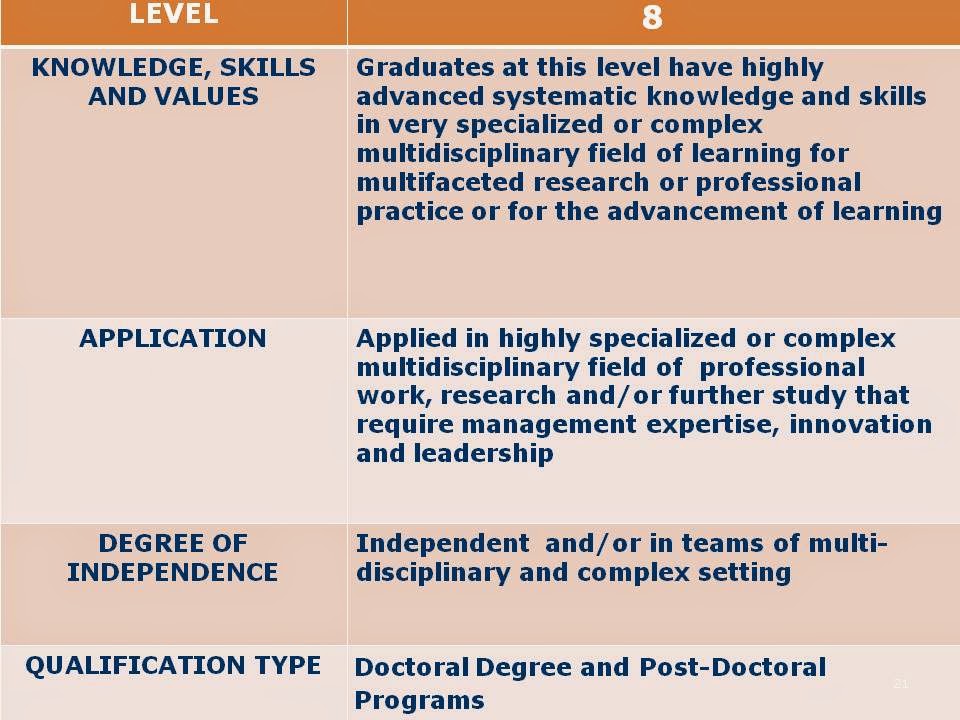
Below is a simplified presentation of the PQF as a result of the consultations with stakeholders. This was presented and approved by the SDC Cabinet Level last May 18, 2012. It outlines the 8-level qualifications covered by the PQF starting from NC I up to Doctoral and Post Doctoral programs.


Level 1

Level 2

 Level 3

Level 4:

Level 5

Level 6: Graduate of a Bachelors degree course

Level 7: Graduate of a Masters Degree course

Level 8: Graduate of a Doctoral and Post-Doctoral degree course


Sunday, January 18, 2015

Establishing an architectural office: Corporations


In many cities, a corporation may be formed by architects. Simply explained, the corporation is a theoretical employer organization and all members (stockholders) are employees with financial responsibility limited by the amount of their investment. When a partnership becomes so large or unwieldy that efficient operation becomes difficult, the partners may decide that a corporation type office with its benefits, would be very interesting.

A corporation is formed by obtaining approval of articles of incorporation from the Securities and Exchange Commission, a charter from the city establishing a board of directors, and electing a slate of controlling officers. A stock issue is provided and may be common stock or preferred stock, the latter having priority or preference when dividends are declared. Stock may have an initial par value or no value and the investors either buy shares, or acquire them by their monetary interest in the office. This cash inflow provides the starting finances for the corporation. The board of directors and elected officers are responsible for the efficient operation of the corporation and all persons work for the corporation as employees and receives a salary, plus stock dividends, plus a bonus, if profits are more than those expected. Market value of stock fluctuates up or down from issue price depending upon amount of dividend or other indications of profitable operation and may not be indicated in stock market quotations.

Financial and size advantages are more rather obvious. With a greater number of stockholders, there is more money with which to work. As a large organization, it is possible to have more employees and more bigger work. Diversification of skills or abilities is also more possible. Departmentalization may also result, again bringing larger and more varied types of projects.

Proper business methods may bring a good return on any investment. All of this large work, larger office, and less personal in-office contact may lead to a feeling of factory workers, and stifled ambitious younger people. With a larger group of principals, it generally works out that individuals develop considerable personal skills in a particular area rather than improving over the entire field, and while some people do not object to a human boss, they do not like to be supervised by a corporation.

Bigness as related to a corporation, has its advantage and its disadvantage. From the standpoint of the client, the large corporate office generally has the advantage of being able to provide expert knowledge in a number of fields, a client wishing to build a special manufacturing plant probably will have better results with a large office with specialized interests, and most such offices are organized as corporations. From the standpoint of the employee, exposure in a large corporate office will give him a much different feel for projects than is generally possible in a small office. This may be good or bad, depending upon the individual. A by-product of a large corporate office may be the better understanding of business as it relates to the design professions.

How to become an ASEAN ARCHITECT (AA)


Who can apply?

An Architect who possesses the qualifications and professional experience requirements specified in Part B of this Assessment Statement may apply to be registered in the ASEAN Architect Register (AAR) and accorded the title of ASEAN Architect (AA). 

Where to apply?

Applications can be sent to the Asean Architect Monitoring Committee of the PRC-PRBOA.
(Under the ASEAN MRA on Architectural Services, the Professional Regulatory Authority (PRA) of each participating ASEAN Member State or in the case of the Philippines, the Professional Regulation Commission (PRC) shall authorize a Monitoring Committee (MC) to receive and process applications of its Architects for registration as AA, and to maintain the AA Registry.) 

What are the qualifications needed?

Any Architect who:
a) has completed a 5-year recognized architectural program or its equivalent in a university or school accredited by CHED;
b) possesses a current and valid professional registration and licensing certificate to practice architecture in the Philippines issued by the PRC;
c) has gained practical and diversified experience of not less than ten (10) continuous architectural practice after graduation, of which five (5) years shall be after licensure / registration;
d) has spent at least two (2) years in responsible charge of significant architectural work;
e) has complied with the CPE/CPD policy of the Philippines at a satisfactory level;
f) has not been convicted or charged of any serious violation of technical, professional and ethical standards, local and international, for the practice of architecture or of any crime which involves moral turpitude.

Note: 
For the CPE, the PRC has set the activities that architects can take for their CPE. Those activities are counted as the Continuing Professional Education Unit (CPEU) and are divided into 8 items as follows:
1. Formal learning
2. Informal learning
3. Seminar, conference and meeting
4. Participation in professional activities
5. Service activities
6. Industry involvement
7. Contribution to knowledge
8. Patents
Different activities however have different weights of score attached to them. See details in the Committee Rules on Continuing Professional Education (CPE).

For other details and format for application (forms are at the last part), see below:
ASEAN MUTUAL RECOGNITION AGREEMENT (MRA) ON ARCHITECTURAL SERVICES


ASEAN MUTUAL RECOGNITION AGREEMENT (MRA) ON ARCHITECTURAL SERVICES

 
Design by Free WordPress Themes | Bloggerized by Lasantha - Premium Blogger Themes | Affiliate Network Reviews